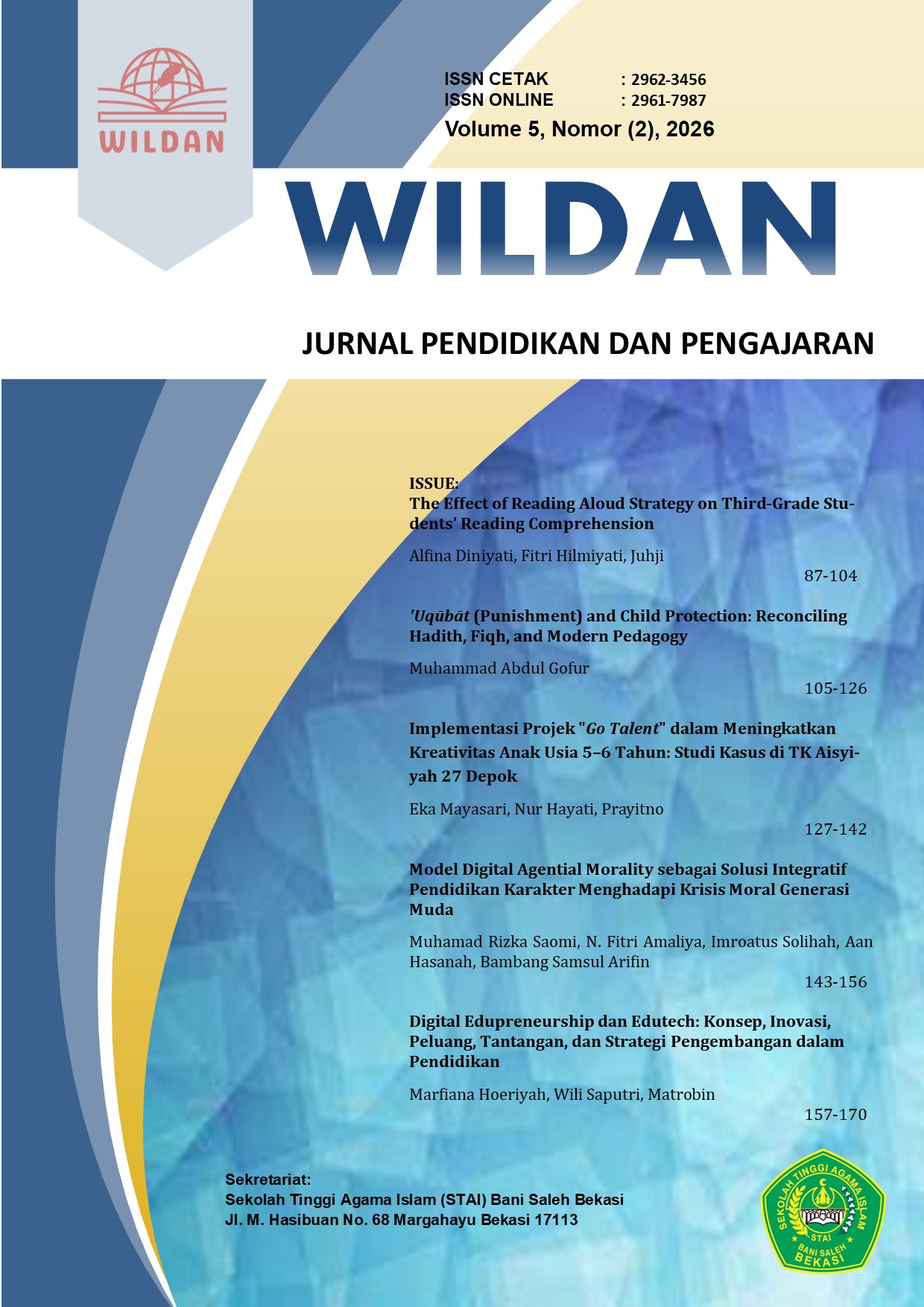
'Uqūbāt (Punishment) and Child Protection: Reconciling Hadith, Fiqh, and Modern Pedagogy
DOI:
https://doi.org/10.54125/wildan.v5i2.142Keywords:
Comparative Jurisprudence, Fiqh Tarbawi, Maṣlaḥah al-Ṭifl, Positive Discipline, ‘UqūbātAbstract
This study aims to conceptualize the reconstruction of the boundaries of ‘uqūbāt (punishment) based on the framework of maqāṣid al-syarī‘ah within Islamic primary education institutions, serving as a resolution to the legal antinomy between the literalism of classical jurisprudence and child protection regulations in Indonesia (Law No. 35/2014). Utilizing a qualitative-descriptive library research design, this study employs a normative-Sharia legal approach alongside a comparative analysis across the four major schools of thought (Hanafi, Maliki, Syafi‘i, and Hanbali). A hermeneutical analysis of the disciplinary Hadith corpus confirms that the dispensation for physical action against ten-year-old children strictly functions as an educational instrument (ta’dīb) rather than a retributive measure (intiqām). Despite technical-quantitative differences among these madhhabs, an absolute consensus (ijmā‘) exists regarding the total prohibition of harmful striking (ḍarb mubriḥ) and any physical contact directed at the child's face, head, and vital organs. Furthermore, positioning the age of five as a pre-tamyīz baseline confirms that the developmental gradations in Islamic law are progressive and linear with the "five-to-seven year shift" phenomenon in modern developmental psychology. This study concludes that there is an urgent need to transform the operational boundaries of sanctions in Islamic elementary schools (SD/MI) toward a positive-restorative discipline paradigm—a framework that positions the principle of the best interest of the child (maṣlaḥah al-ṭifl) as the supreme legal maxim to satisfy the foundational tenets of protecting life (ḥifẓ al-nafs) and intellect (ḥifẓ al-‘aql). Practically, this study recommends the formulation of an applicable Student Discipline Code of Ethics for educators as an operational guideline to enforce child-friendly discipline while preventively mitigating the risk of teacher criminalization.
References
Al-Kāsānī, ‘A. B. (1986). Badā’i‘ al-ṣanā’i fī tartīb al-syarā’i‘ (2nd ed., Vol. 7). Dār al-Kutub al-‘Ilmiyyah.
Anwar, S. (2023). Konsep ta'dib dan uqubat dalam pendidikan Islam modern. Samarah: Jurnal Hukum Keluarga dan Hukum Islam, 7(2), 510–532. https://doi.org/10.22373/sjhk.v7i2.16450
Awaluddin, R. Z. S., Sabililhaq, I., & Nida, S. (2024). Reimplementation of madrasah ramah anak in building discipline character of students. ATTARBIYAH: Journal of Islamic Culture and Education, 9(2), 193–212. https://doi.org/10.18326/attarbiyah.v9i2.193-212
Crain, W. (2020). Theories of development: Concepts and applications (6th ed.). Routledge.
Fadli, M. R. (2021). Memahami desain metode penelitian kualitatif. Humanika, 21(1), 33–54. https://doi.org/10.21831/hum.v21i1.38075
Hidayat, R. (2024). Hermeneutika hadis-hadis disiplin anak: Tinjauan interdisipliner psikologi perkembangan. Ahkam: Jurnal Ilmu Syariah, 24(1), 89–114. https://doi.org/10.15408/ajis.v24i1.31205
Ibnu Qudāmah, A. M. A. A. (1997). Al-Mughnī (A. A. Al-Turkī & M. A. Al-Ḥulū, Eds.; 3rd ed., Vol. 8). Dār ‘Ālam al-Kutub.
Ishak, M., Yahiji, K., Husain, R. T., Ibrahim, S., Ishak, M., Yahiji, K., Husain, R. T., & Ibrahim, S. (2025). Perspektif hadits tentang pemberian hukum terhadap anak. 4(1), 11–22. https://doi.org/10.58194/jiemr.v4i1.2157
Muhammaddiah, M. R. bin, & Safitri, R. (2025). Restorative Justice and Child Protection in Sharia Law: A Maṣlaḥah-Based Analysis from Langsa Sharia Court. Al-Jinayah: Jurnal Hukum Pidana Islam, 11(1), 1–25. https://doi.org/10.15642/aj.2025.11.1.1-25
Majid, A. (2014). Belajar dan pembelajaran pendidikan agama Islam. Remaja Rosdakarya.
Mansari, Mansari, dkk. (2022), Uqūbāt Terhadap Jarimah Zina Yang Melibatkan Anak, Jurnal Yudisial, 14(3), 375-393. https://doi.org/10.29123/jy.v14i3.436
Marzuki, I. (2023). Metodologi penelitian hukum Islam: Pendekatan normatif dan komparatif. Dialektika.
Ma'tuq, Ahmed Ali. (2023). Al-'Uqūbāt wa Aḥkāmuhā fī asy-Syarī'ah al-Islāmiyyah, Majallah al-Muntadā al-Akādimī, 7(1), 411-450. https://doi.org/10.59743/jaf.v7i1.265
Mu’ammar, M. A. (2024). Metode komparasi mazhab dalam hukum Islam kontemporer. Pustaka Pelajar.
Mubarok, F. (2025). Genealogi tamyiz dalam hukum Islam: Rekonsiliasi batas kronologis dan kematangan kognitif. Studia Islamika, 32(2), 143–168. https://doi.org/10.36712/sdi.v32i2.35410
Ramadhan, H. (2023). Neurosains dalam pendidikan Islam: Transformasi metodologi pembelajaran berbasis perkembangan otak. Kencana.
Safni, P. (2024). Code of conduct for appropriate punishment of children in Islamic education. Maklumat: Journal of Da'wah and Islamic Studies, 2(4), 194–202. https://doi.org/10.61166/maklumat.v2i4.26
Samak, Nur Laili & Harsiwi, Nova Estu. (2025). Pendekatan Taktis Guru Dalam Penanganan Anak ADHD Di SDN Banyuajuh 2 Bangkalan. Edu Research, 6(2), 966-974. https://doi.org/10.47827/jer.v6i2.899
Sameroff, A. J., & Haith, M. M. (Eds.). (1996). The five-to-seven year shift: The age of reason and responsibility. University of Chicago Press.
Santrock, J. W. (2019). Life-span development (17th ed.). McGraw-Hill Education.
Siegler, R. S. (2016). How children discover new strategies (2nd ed.). Psychology Press.
Suharto, T. (2022). Sistem analisis isi dalam penelitian teks turats keagamaan. Ilmu Ushuluddin Press.
Undang-Undang Nomor 35 Tahun 2014 tentang Perubahan atas Undang-Undang Nomor 23 Tahun 2002 tentang Perlindungan Anak. Lembaran Negara Republik Indonesia Tahun 2014 Nomor 297.
Yuniarti, D. R., Sahid, M., & Faisal, B. I. (2025). Recontextualization of ta’zir in the world of education: Bridging Islamic values, children's rights, and pedagogical practices. JISIP (Jurnal Ilmu Sosial dan Pendidikan), 9(3). https://doi.org/10.58258/jisip.v9i3.8712
Downloads
Published
How to Cite
Issue
Section
License
Copyright (c) 2026 Muhamad Abdul Gofur

This work is licensed under a Creative Commons Attribution-NonCommercial 4.0 International License.
This journal permits and encourages authors to post items submitted to the journal on personal websites or institutional repositories both prior to and after publication, while providing bibliographic details that credit, if applicable, its publication in this journal.